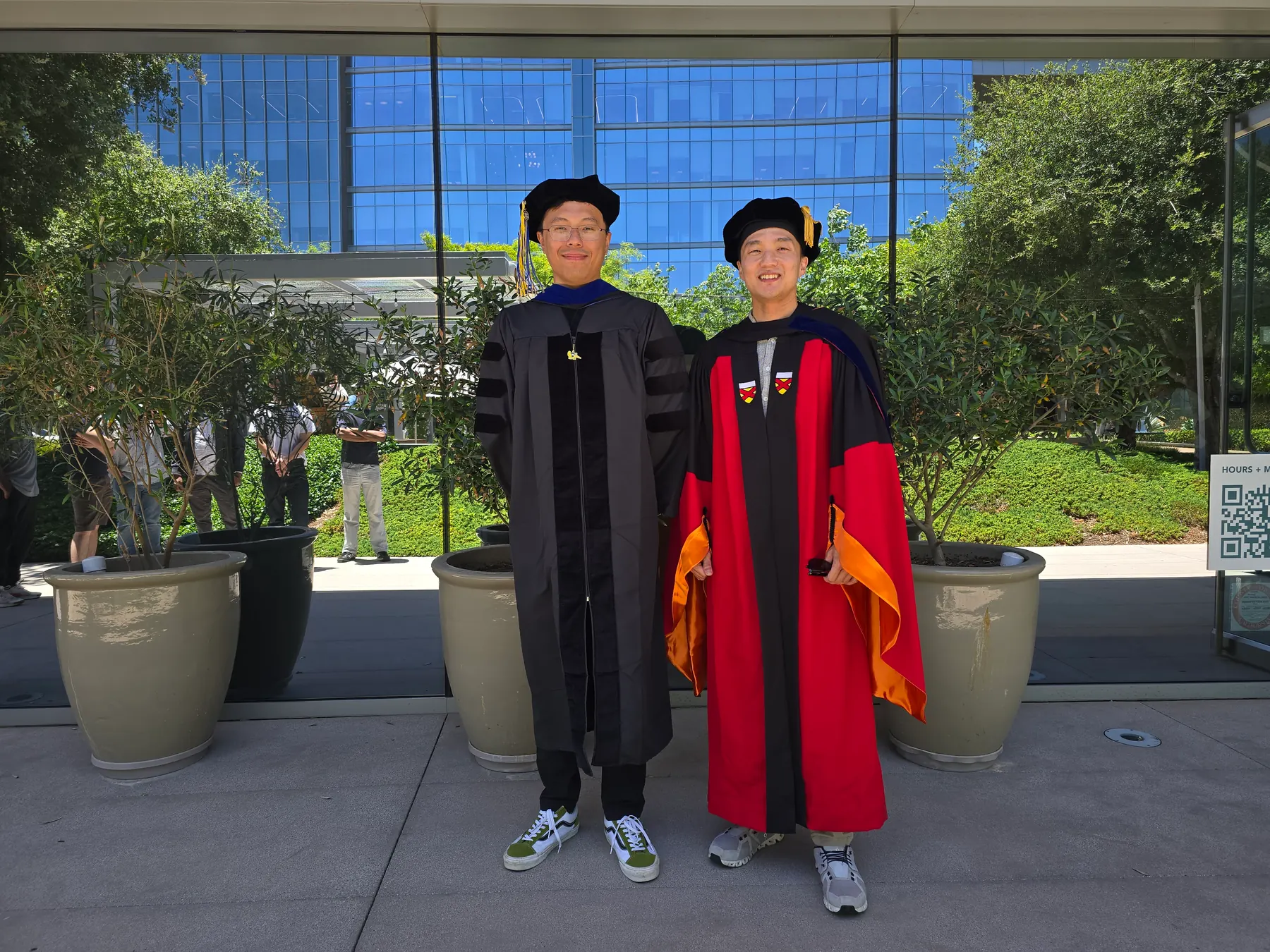
I grew up in a family where my parents did not receive much education. They could not tell me what I should become, but they gave me something equally valuable: the freedom to explore. I grew up curious, and perhaps a little too unconstrained.
In high school, I competed in physics and programming and won a few modest awards. But I also spent too much time on video games and young love. I entered a top university in China, yet remained unsure of my direction. I immersed myself in student clubs, international communities, and art. My academics suffered. I received a D in advanced mathematics and even an F in fluid mechanics.
Those failures eventually forced me to ask a simple question: What kind of work deserves the best of me?
My answer was engineering and science. I came to UC Irvine for a Ph.D. in Mechanical Engineering. I wanted to build things that matter, and become an engineer.
There is an irony I still enjoy. The Navier-Stokes equation I once struggled with became the equation I derived countless times during my Ph.D. It became almost like an old friend. Sometimes I joke that if I had fallen in love with it ten years earlier, perhaps I would have graduated from Stanford.
Around 25, my trajectory changed. Once I knew what I wanted, I became intensely ambitious about getting there. I stopped measuring myself by what professors, mentors, or managers expected of me. Their expectations became the baseline. My own became much higher.
I also stopped letting my environment define what I could do. In a heat-transfer lab, I ventured into AI. At NVIDIA, I brought advanced thermal engineering into optical systems. In a traditional manufacturing company, I pushed my way into deep tech. Each step brought me closer to the frontier and to the engineer I wanted to become.
The more responsibility I was given, the more I wanted. The harder the problem, the more alive I felt. I no longer needed someone else to tell me how far to go.
I was not taught to become an engineer. I chose to become one.